For OPENBIM, is IFC enough?
对于OPENBIM,有IFC就够了吗?
Official Account: Non-Deconstructive · Author: Zhou Wenqi (Venchy)
How to connect the traditional architectural design process through BIM to improve the quality and efficiency of the entire design process? This topic has been discussed and studied by many designers and engineers. There are currently two mainstream solutions: One is the technical route represented by Revit, which hopes to be comprehensive in the entire design process and allow its own tools to penetrate into all aspects of design. Due to the cumbersomeness of Revit itself, this solution has been criticized by the majority of designers and engineers. Although teams exploring this technical route have continued one after another, there have been few successful cases.
The other is the technical route represented by Archicad, which uses OPENBIM to integrate existing tools and working models in various professions and processes. This technical route has been praised by many architects, and many architects have indeed tasted the benefits of Archicad, and Archicad has always advocated OPENBIM’s technical route. As a leading profession, many architects also place their hope in OPENBIM to improve the current production model.
In the vision of the OPENBIM production mode architecture, data needed in various disciplines such as architecture, structure, HVAC, and design, construction, operation and maintenance and other stages of the building life cycle can be interacted through IFC. Many people have high expectations for IFC, believing that it is the savior to solve the format interaction problems between most BIM software, and is even a key bridge between traditional design software and BIM design software.
So, what is IFC?
IFC is the abbreviation of Industry Foundation Classes, and its history can be traced back to 1994. IFC is a product of the Automotive Alliance for Interoperability, which was established by Autodesk. The alliance became the International Alliance for Interoperability in 1997 and is now known as buildingSMART, a non-profit organization that bills itself as the international headquarters of openBIM.
IFC is a platform-independent open file format specification that is not controlled by a single vendor or a group of vendors. It is an object-based file format, data model developed by buildingSMART (formerly the International Alliance for Interoperability, IAI) to promote interoperability in the architecture, engineering, and construction (AEC) industry, and is a commonly used form of collaboration on Building Information Modeling (BIM) projects. IFC has gone through 1.0, 1.5, 1.51, then 2x, 2x2, 2x3 and 4 versions. The IFC model specification is public and available. It is ISO registered and is the official international standard ISO 16739-1:2018.
IFC provides complete documentation on IFC data structures: https://standards.buildingsmart.org/IFC/RELEASE/IFC4/FINAL/HTML/
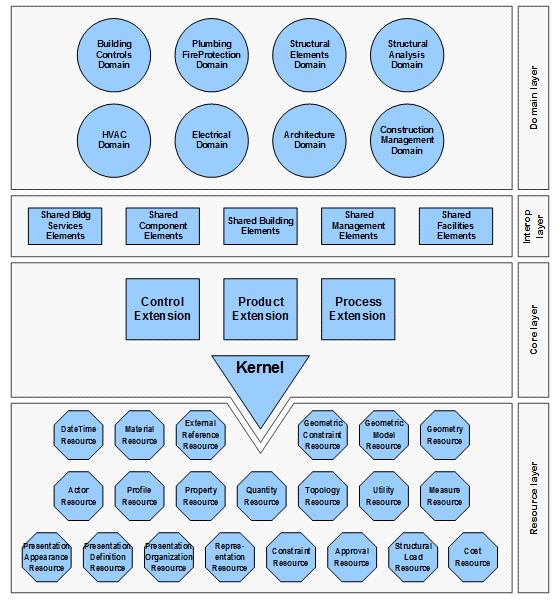
IFC contains approximately 800 entities, 358 attribute sets and 121 data types. Such a huge data system covers all aspects of the building life cycle. Facing such a comprehensive system, the editor’s first feeling is that it can help me solve many problems. The editor has previously tried to parse some IFC models and obtain the data. During this process, the editor did have some questions:
- 表达能力强=数据可用?
In the process of developing some IFC-related functions, the editor really felt the power of IFC. According to the editor’s understanding, the building itself is composed of many geometric units. Whether it is building components or building space, it can be expressed in a geometric way. The building information model is essentially based on geometric information, with some additional defined building information. Taking a column as an example, it can be expressed by a cube, and then attached with information such as the concrete label, which constitutes the definition of the column in the BIM model. In IFC, IfcColumn is used as the data format for expressing columns. We can obtain any properties of the component through the IsDefinedBy property in IfcColumn. We can also obtain the geometric shape and coordinate information of the component through the Representation and ObjectPlacement properties in IfcColumn.
Looking at the geometric information, as the understanding continues to deepen, the editor is really feeling that the expressive ability of IFC’s geometric information is really powerful and can be described as “all-inclusive”.
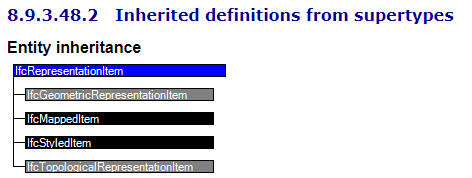
The Representation property of IFC is expressed by IfcRepresentationItem. Among them, the geometry is expressed by two data types: IfcGeometricRepresentationItem and IfcTopologicalRepresentationItem.
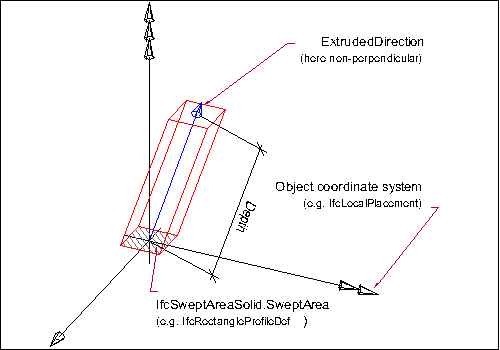
Let’s take a square pillar as an example. We can express it in many different ways. Here are two simple examples: (1) Construct an extruded body through IfcExtrudedAreaSolid. Define the cross section of the column through IfcProfileDef, and define the direction and length of the column extrusion through IfcDirection and IfcPositiveLengthMeasure.
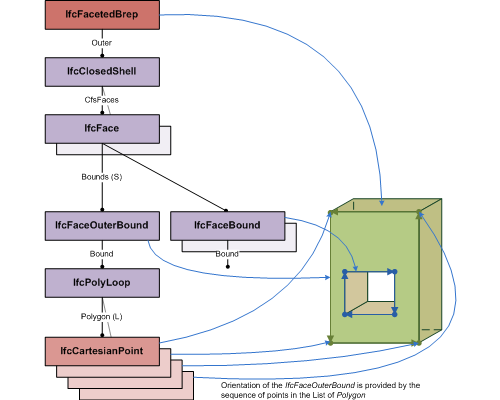
(2) Construct the Brep of the column through IfcFacetedBrep. The so-called Brep is the abbreviation of Boundary representation, which jointly describes a geometric object through corner points (Vertex), boundary (Edge), face (Face) and entity Brep. For a hexahedral column, we need to define 8 corner points, 12 boundaries, and 6 faces. This is a geometry expressed through topological relationships. Similarly, we can also express this relationship through IfcClosedShell under IfcTopologicalRepresentationItem.
For the architectural profession, if they simply want to obtain the shape of the component, the above expressions may be able to meet the corresponding needs, but for other professions, these expressions do not seem to be sufficient to meet the requirements. For example, when generating a finite element model of a structure, the column is generally expressed through a line and a section. If it is an expression like IfcExtrudedAreaSolid, how do we get the cross-section of the component through IfcProfileDef? How do we get the axis of the column through IfcDirection and IfcPositiveLengthMeasure? For columns constructed with IfcFacetedBrep, this seems to become more difficult. The transformation from IFC model to structural design model requires a series of geometric operations. From this logic, IFC only achieves a comprehensive display level, but does not fully consider the individual needs of each profession for data. When I need a certain column, it can indeed provide me with information about this column, but it cannot directly provide the information I want.
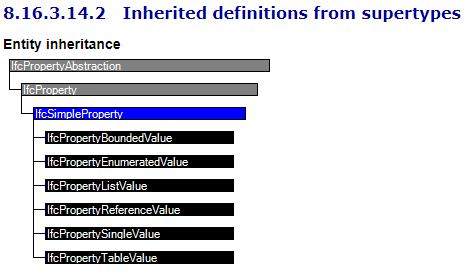
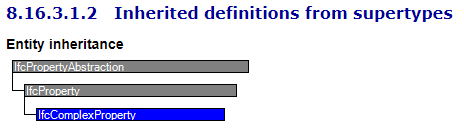
Let’s look at the additional properties of the component defined by IsDefinedBy. In IFC, several IfcPropertySets are defined to represent additional properties to be attached to the component. Several IfcProperties are defined in IfcPropertySet. The data structure of IfcProperty can be seen in the figure below. We can express the properties of components through data structures such as Boolean values, lists, characters, etc.
Let’s look at the IFC properties of a component:
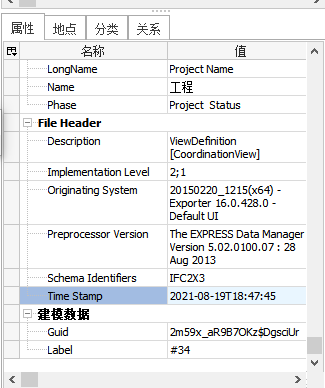
Indeed, IfcProperty gives us considerable freedom to describe building components. It can be said that from the perspective of data diversity, this design is really impeccable. However, this brings another problem. When I parse the corresponding IFC model, I need to parse it according to the clear description of the IFC model-related data. When some data is not so clear at a glance and we cannot clearly know its meaning, or when the definition of the data is misaligned with our previous understanding, it becomes a problem whether we can correctly parse the corresponding data and obtain the information I want.
- Full data = seamless connection between platforms?
The IFC standard can indeed express a structure very comprehensively. Many friends believe that its powerful ability can solve the problem of BIM data interaction across disciplines and processes. The editor has to put a question mark here.
To give a very simple example, we export the data in Archicad to IFC, then import it into Revit, then export the data in Revit, and then import it into Archicad in reverse. At this point, can we guarantee that the final model in Archicad is the same model as the Archicad model initially exported? With a high probability, it is difficult to guarantee.
Because in the process of transmitting and interacting with IFC data, there is a problem of inconsistent expression methods or expression standards between platforms. What kind of collective expression do I use when expressing a column? What attributes and fields do I use to express the properties of a column? As long as there is a little compatibility issue, we cannot fully guarantee the accuracy or reliability of the data.
其实这里就牵涉到了数据的加工方和数据的使用方之间对接交互的问题。确实,我们的IFC数据的表达能力很强,它能够满足我们方方面面的需求。此时,数据的使用方就要和数据的加工方达成某种协议,明确对数据的需求和对数据的表达方式的需求。只有双方在共同的默契下协同工作,才能保证IFC交互过程中数据的可靠性。
In the process of promoting BIM in the industry chain, everyone has been emphasizing the importance of data standards for the collaboration of all parties, and everyone has indeed seen the strong ability of IFC to meet everyone’s needs for BIM data in all aspects. The editor understands that to some extent, IFC is in a state of failure. Indeed, strong expression can bring as many people as possible together under this standard. However, strong expressive ability also represents a specific, but not so specific state. Based on IFC, data that looks exactly the same may be expressed in countless ways. We need to get the correct key to use the corresponding data correctly. It is equivalent to saying that IFC is a broad data structure. People who use it must develop their own set of interaction standards based on this data structure.
At present, most software manufacturers may be in a state of fighting on their own, which fully reflects the freedom of data, but rarely considers the compatibility between data.
写在最后
In the editor’s opinion, the IFC standard is essentially the same concept as the CAD drawings we used before. Each design institute has its own layer system and its own CAD-based collaboration method. The working model based on IFC cannot change this state, but only changes the subject from each design institute to each software manufacturer. The gap between software vendors is even more difficult to bridge, because each software vendor has its own area of expertise and its own understanding and needs for data. It is true that every manufacturer can express its own data based on IFC, but can every manufacturer allow upstream and downstream users to use their own data correctly and without any obstacles? Finally, back to the title of this article: For OPENBIM, is IFC enough?
加入QQ群(3群),我们一起来探索 The infinite possibilities of YJK-GAMA!

Welcome to contact us 加入“建筑结构数智化设计”微信交流群, Let’s communicate and discuss cutting-edge technologies such as digitalization and intelligence Application in the architectural design industry.

We also welcome like-minded partners to join us. 一起来做点好玩的事情。

We will bring you more surprises in the future, 关注我们公众号吧!
本文档由AI从非解构公众号自动采集整理,仅供学习参考。
Original Source: https://mp.weixin.qq.com/s/rQmFGfZwFG5UybtBmMww5g
LOADING…